

Harmony is the real value. Always strive for harmony within and around you, as it secures health and supports a pro-life orientation.
True mental wellbeing doesn’t begin with external achievement, perfect conditions, or the absence of challenge.
It begins with knowing who you are as True Self. It is present in inner calmness that you are able to keep in any situation.
Your natural inner state is silent and calm, in full harmony.
However, most people have lost this inner peace and struggle with constant inner noise and turmoil.
Only when harmony is present internally, your nervous system can settle, your mind can become clear, and your conscious capacity to respond rather than react subconsciously expands.
When harmony exists within your own inner domain, you can bring quality to the relationship you maintain. This, in turn, fosters greater harmony in workplace relationships and the organizational environments you help shape.
The fact is, when leaders and employees join forces and cultivate harmony externally, it permits more conscious contribution.
The joint development of inner and outer harmony forms the foundation of sustainable mental wellness and work engagement at the individual and organizational levels.
The Lightness of Being Grounded in True Self and Self-Love
Self-love is the energetic aspect of Your True Self. Self-Love radiates in the present moment without any interruptions until you actively know the True Self.
In essence, the True Self is most similar to inner silence.
Awareness and sensing are also silent levels (see the graph below). Those silent inner levels are harmonious and secure, calm action when you have active contact with them.
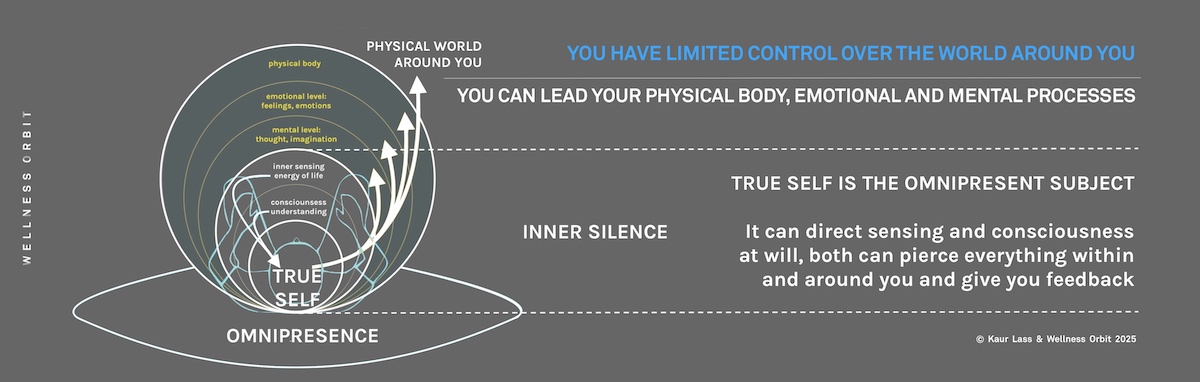
Inner harmony shines when your mind is calm and has stopped the subconscious processing of imagination, thoughts, emotions, desires, fears, or anxiousness. However, most people fear the blankness of their mind and therefore try to fill it.
When you identify with the subconscious imagination, thoughts, emotions, desires, fears, or anxiety, you lose contact with the inner peace and True Self. As a result, inner harmony is replaced with inner turmoil.
When your mind is constantly controlling things, pressure starts to build. It appears in the form of stress, burnout, or even mental health issues. Luckily, this development of health issues is slow. Provided that you learn to observe what happens within your mind and train intrapersonal skills to become excellent, self-leadership becomes possible.
Your power to lead awareness allows spotting inner changes and adjust them before they become problematic.
Your ability to make conscious choices is what sets you free to keep focus, access creativity, insights and intuition. In essence, it gives you the inner ability to respond.
The ability to respond consciously is much different from galloping and restless subconscious reactivity. Responsibility is light, and taking it unfolds in the present moment.
The lightness of your being, as True Self, is what empowers you to be the fully conscious co-creator of harmony around you.
The ability to remain calm and grounded in the True Self matters the most when you need to engage your mind and body actively with the demands of life and work.
Change Is Constant — Relaxation amid changes is a Skill
Within the outer world, change is constant.
Markets shift, roles evolve, technologies advance, and all subconscious relationships move through different seasons. Your subconscious attempt to fix external conditions is mostly exhausting and futile.
What sustains life isn’t the trial to eliminate change, but your inner power to notice how to contribute and restore harmony amid changes. That power can’t be automatic or habitual.
Your real inner power can only be a conscious choice.
This conscious choice is unfolding as life flows and is based on your conscious capacity to spot how to restore harmony. Both within and around you, and it flows when such conscious choice is your deliberate practice.
However, developing such inner power demands that your mind is calm enough to notice the reality, as this allows take responsibility over if, when and how to get involved into actual life or work situation.
Mind Health Training and the Foundations of Self-Leadership
Most people are never taught how their inner domain actually works. Our school system lacks intrapersonal education. No wonder that the foundations of self-leadership are weak, as people lack intrapersonal skills.
What is the result?
People experience imagination, thoughts, emotions, desires, fears, and anxiety as reactionary forces that simply happen to them. As a consequence, self-doubt often floods the mind before an important conversation. Fatigue accumulates until clarity disappears.
Without awareness and practical intrapersonal skills, these subconsciously triggered processes remain largely impossible to lead at will. Consequently, unmanaged pressure turns into stress. Next, this stress at work or related to entrepreneurship becomes chronic, and then the burnout cascade starts to slowly unfold. Health issues will later follow.
Self-leadership begins with awareness of awareness and sensing. Awareness equips you with the capacity to observe what is occurring inside the mind and body. Such observation unfolds without immediate identification or automatic reaction.
Awareness also empowers you to observe different external processes and situations with a calm mind. You no longer react, but instead make conscious choices when and if needed.
When you train awareness-based intrapersonal skills, you widen your inner capacity to make conscious decisions and contribute without losing your mental wellness in the process.

Making Inner Processes Leadable
Mind health training is what widens and deepens your capacity to respond calmly and run everything through the pro-life filter. This allows you to sustain inner harmony and consciously contribute to keeping or restoring external harmony.
In harmonious work environments, creativity and innovation can thrive.
Training in intrapersonal skills is what permits people to recognize the difference between external stressors and internal reactivity.
When intrapersonal skills are consciously applied, then over time, individuals become less dominated by habitual subconscious loops. When conscious response dominates in the collective, workflow and human relations improve.
So, mind health training is about understanding the hierarchy of different inner processes that take place in your own inner domain.
|
This understanding, combined with practical intrapersonal skills, is what makes them leadable. Removal of all automatic subconscious processes is the ideal, but striving towards it is both an individual and collective effort.
Only when people develop practical intrapersonal skills, harmony within them, and around them becomes something they can sustain. Internally, it means the constant mental background noise of self-judgment, anticipatory worry, and unresolved tension can begin to settle. Externally, communication improves because people are less likely to project their inner pressure onto others.
A calm and supportive work environment is not a question of perks and impeccable equipment alone; it also has a mind-health-related dimension. Fit and calm-minded people work well and take time to relax, so that they don't burn out and lose their health.
Harmony at Work: From Reactivity to Sustainable Contribution
Teams function with greater psychological safety when individuals can regulate their own inner states. Leaders and employees listen and notice more. Therefore, they can make clearer decisions as their judgment is no longer clouded by reactive imagination, thought, and emotional patterns.
When people get off the reactive autopilot mode, the quality of presence rises, and with it, the quality of work and relationships also improves.
Sustaining harmony or lacking it has direct implications for mental wellness in the workplace. Chronic stress and burnout rarely appear suddenly in peaceful and harmonious surroundings.
Stress, anxiety, burnout, and work-related (mental) health issues accumulate when people remain in prolonged states of inner dissonance and under external pressure without taking time to relax.
When intrapersonal skills are lacking, the subconscious need for approval drives performance based on positive stress. Positive stress is often falsely considered good and part of motivation. The fact is, most burnout happens because of the accumulation of long-term positive stress.
Presenteeism often reflects this condition: the human body is present, but the mind is fragmented, depleted, or quietly overloaded.
Absenteeism and disengagement follow a bit later when the subconscious system can no longer compensate for the resulting inner noise, worry, emotional turmoil, stress, anxiety and fears. People who burn out the most are those who are good at delivery and results. Irresponsible and careless people burn out much less than fast-reacting professionals. What few notice is that the reactivity is the problem.
Organizations that focus only on external performance metrics while neglecting the inner subconscious reactional patterns of people eventually pay the cost in lost energy, reduced creativity, and a rise in mental and physical health conditions.

Integrating Intrapersonal Skills and Organizational Responsibility
The conscious leadership approach integrates personal development to support co-creation and co-operation. This allows the free will of people to align for a joint effort. Also, this can boost wellbeing and organizational functioning simultaneously.
Only when individuals are supported in training intrapersonal skills and self-leadership can they regulate their inner states more effectively. This, in turn, improves relations within the team as well as relations with the customers.
At the same time, leaders also need to examine the organizational setup: all structures, overregulation, and expectations that generate unnecessary pressure need to be removed. Rules and regulations can never compensate for responsibility, ethics, and calm-minded conscious choices.
Harmony isn’t achieved by ignoring the need for personal capacity and restoration time. It emerges when resilience is seen on the personal and organizational level.
Securing mental wellness proactively is both an organizational and an individual task. It starts with knowing how to keep a healthy mind and spreads into collectively securing healthy work environments where there is a right to try, fail and learn.
Those who have good intrapersonal skills can cultivate harmony within themselves and co-create it around them. This is what empowers professional skills and work relationships without taking a toll on health and the quality of personal relationships.
Conclusion
Mind health training is what equips people to lead different processes within their inner domain. Conscious leadership can then follow and focus on how to reduce different external strains.
The power to restore harmony amid change is, ultimately, a trained capacity.
It rests on the ability to return to inner peace. Inner calmness is founded in knowing the True Self and understanding how to use awareness and intrapersonal skills. From that peaceful inner ground, it becomes easy to engage with the outer world constructively. When this becomes a living practice rather than an occasional ideal, health is protected, relationships deepen, and life retains its generative quality even under pressure.
People with fit and calm minds contribute to sustaining environments in which others can also stay clear, engaged, and resilient. In a world of constant change, this capacity is one of the most practical and pro-life skills people can develop.
|